Sunday, November 2

where am I


After a roughly year-long break, I've decided to start blogging again. Instead of keeping things going full time here at the Built Environment Blog, though, I'll be contributing several posts a month to Where, which has evolved into an interdisciplinary forum on urbanism with 11 international writers. Needless to say, I'm thrilled to be involved -- it promises to be an interesting endeavor. (I also got to design the banner!)

Friday, October 19

not so superblock

In an interview with the New York Observer several months ago, the Atlantic Yards' landscape architect Laurie Olin dismisses the common stigma against superblocks as clichéd "1960s language." His own arguments for them, however, echo the naïve idealism of planners from that very era. "If I put a street through here," he states, "[then] I have less space for people and I have more cars… When people say 'superblock'— what's wrong with what this is? Because I don't see how adding one car in here is going to make it a better space. I think space on streets is actually useless space."

The current plan for Atlantic Yards involves the demapping of several streets and the creation of a residential superblock. Site Plan via Atlantic Yards Report.

The superblock, put very simply, is a development form larger than a traditional city block. According to civic-minded urban theorists in the mid-20th century, residents of superblocks would be liberated from cars in their everyday life, living freely as denizens of self-sufficient pedestrian communities. The scale of these superblocks, wrote Bauhaus urban planner Ludwig Hilberseimer, would allow them to "preserve an organic community life" in the face of automobile-based cities of the future. (The Nature of Cities, 1955.)

hilberseimersuperblock_a.jpgConcept for Heerstrasse and University of Berlin, 1937. Ludwig Hilberseimer. Scanned from The American City: What Works, What Doesn't by Alexander Garvin. Hilberseimer worked with Mies van der Rohe on the United States' most successful superblock project: Lafayette Park in Detroit.

In practice, completed superblock projects rarely approach Hilberseimer's utopian vision: for the most part, superblock projects are boring and institutional. At worst, the designs encourage crime and neglect.

The NYU Silver Towers project north of Houston between Mercer and LaGuardia demonstrates the detrimental effect that the demapping of streets to create superblocks can have on the public realm. Despite an elegant design by I.M. Pei and a plaza with public art by Picasso, the modest superblock is a dead zone in the Village's otherwise vibrant public realm. Compared to neighboring SoHo – which has streets filled with a jumble of people and uses – the Silver Towers are a public realm failure.

NYU’s Silver Towers, a superblock created by the demapping of Wooster and Greene Streets, lacks the vitality of the smaller blocks that surround it. Photo by Hubert Steed.

With the rise of New Urbanism and the canonization of Jane Jacobs, superblocks became a sort of urban design taboo – the quintessential example of high-minded architectural theory failing in real world application. Thus of the myriad flaws in the plan for Ratner's Atlantic Yards development in Brooklyn, perhaps the most surprising, from a design perspective, is its return to the superblock form. In the words of the Manhattan Institute's Julia Vitullo-Martin, "Do we not all agree with Jane Jacobs that the urbane mixtures of buildings of varying age, condition—inevitably swept away by the superblock—are a necessary condition of thriving urban life?"

Apparently not.

One dissenter, it seems, is Olin. In the past, Olin has demonstrated an incredible ability to create beautiful public space enclaves in crowded urban environments. At the Getty Center in L.A., he worked with Richard Meier to create a hilltop oasis for art; at Bryant Park, he collaborated with William Whyte to carve a cozy community park from the mind-boggling intensity of Midtown Manhattan.

Bryant Park. Photo from Forgotten NY.

Unfortunately, Olin's talents do not always translate well into projects meant to integrate into the fabric of the city, rather than stand out from it. At Canary Wharf in London – like Atlantic Yards, a mixed-use high-rise development on a post-industrial site – the public spaces planned by Olin are impersonal and lack activity. Despite crowds of people working in the area, the wharf's public spaces are often nearly deserted. (It's said that the Radiohead's Fake Plastic Trees is about Canary Wharf, even though the trees are real. For more criticism, see the Project for Public Space’s Hall of Shame.)


Canary Wharf Tube Station, London, U.K. Image from yuki*.

In the chapter of The Death and Life of Great American Cities entitled "The Need for Small Blocks," Jacobs bemoans the "myth that plentiful streets are 'wasteful.'" She argues that it is, in fact, large blocks that lead to wasted space by constricting "economic use [to] only where [people's] long, separated paths meet and come together in one stream." The consolidation of economic activity to confined geographic areas leads to a "depressing predominance of commercial standardization... [and] the Great Blight of Dullness." Ultimately, it is the presence of streets where things can "start up and grow" that lead to economic vitality and vibrant public space.

needforsmallblocks_2Potential pedestrian paths on large blocks (left) vs. potential pedestrian paths on short blocks (right.) From The Death and Life of Great American Cities, by Jane Jacobs.

In his defense of the Atlantic Yards superblock, Olin ignores the lessons of Jacobs while also revealing a fundamental misunderstanding of Brooklyn's streets. In vibrant neighborhoods like those surrounding Atlantic Yards, streets are more than a means of reaching a destination: they are the destinations themselves. Besides providing a place for cars to drive, Brooklyn's streets host a diversity of restaurants, stores, and cultural institutions – all of which serve customers arriving via public transportation or on foot. Moreover, the borough often closes its avenues completely to traffic to host festivals and fairs, events that have helped to give Brooklyn the value that Ratner, the Atlantic Yards' developer, is so eager to capitalize on. By asserting that "space on streets is actually useless space," Olin demonstrates a profound ignorance regarding Brooklyn's urban form.

The Atlantic Antic, Brooklyn, NY. (This festival takes place on Atlantic Avenue -- the northern limit of the of the Atlantic Yards development.) Photo from Apollonia666.

Perhaps what is most surprising about the Atlantic Yards' superblock plans isn't the designers' defense of the concept, but the support it has from its developer. Small blocks, Jacobs makes it clear, are better for business. If he knew better, Ratner would be pushing for more streets – not fewer. Indeed, the superblock is neither a pedestrian-friendly design statement nor a wise investment – it's just a mistake.

Monday, October 8

prison payola

The Next American City just released an issue focusing on crime for which I wrote an article on prison privatization. It was a fascinating topic to research, but also incredibly frustrating: there are lots of examples of what doesn't work well and very few of what does.

Photo from NY Times

If you haven't seen The Next American City, check it out -- it's an interesting organization and the magazine has a thoughtful, interdisciplinary approach to urbanism.

If you're interested learning more about prison privatization, there's lots out there. Crime Pays is an award-winning radio documentary about private prisons. The New York Times featured a great article on the topic earlier this year. Finally, for a rigorous analysis of the ethics of private prisons, see State Punishment and Private Prisons, a piece that appeared in the Duke Law Journal in 2005.

Wednesday, August 29

hiatus

I had been wondering if grad school would leave me enough time to keep writing the Built Environment Blog, and after one day in the studio I have my answer: no.

Also, an earthquake hit yesterday -- my first! It was apparently a 3.0, but I didn't really feel it, I just heard a big rumble.

Even though I won't be writing long posts like fireproof or Grand Army Plaza, Built Environment Blog won't be totally static. The links from del.icio.us and photos from flickr will keep updating, and I'll try to share interesting discoveries about the Bay Area as I make them.

IMG_5129.JPGBerkeley Rose Garden

If you're looking for something interesting to read online, there's still no better place than BldgBlog. Things Magazine is another source for awesome stuff, and Where keeps getting better.

Monday, August 13

cross country

I recently completed a two-month trip across the country. There were two legs of the journey and I took lots of photos on both of them. The first part, from Brooklyn to Chicago by car, took place at the start of the summer. The second part, from Chicago to the Bay Area by plane, took place at the end. Each leg provided a distinct perspective on the American landscape and I had a window seat for both.

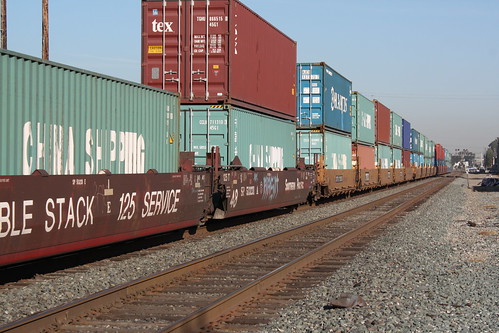
IMG_0659aFreight train, Ohio.

From the car, I saw a thin slice of the country, but from quite close. In addition to hearing the horns of freight trains, I could also smell the chicken coops. (It makes you wonder what they do in there...)

From the airplane, I saw a broad swath of the country from a great distance. On the one hand, I could really appreciate the geography of the American West. (I was particularly drawn to its dams and reservoirs.) On the other hand, I didn't get to go to any of the places I saw.

IMG_3925_b_b.jpgFarmland, California.

On both segments of the trip I saw farms. There are, I learned, lots of different kinds of farms.

IMG_0246.JPGFarmland, Pennsylvania.

Some farms are center pivot irrigated -- watered by sprinklers that rotate around a central point. From the ground, these sprinklers look a bit a like a suspension bridge, fork-lift, and garden hose all rolled into one device.

IMG_0683.JPGCenter pivot irrigation sprinkler, Ohio.

The true beauty of center pivot irrigation, however, is only visible from above. By virtue of their radial design, farms using the system have crops arrayed into circles. Sometimes the countryside looks like it's covered in pie-charts.

IMG_3894_b_b.jpgCenter pivot irrigated farms, Southwestern US. (Central pivot irrigation has been used to grow crops in the Sahara!)

Another kind of 'farm' I saw didn't grow anything at all: it produced power.

IMG_0270.JPGWind farm, Pennsylvania.

The first wind farm I saw was in western Pennsylvania. The towering three-bladed turbines were a striking juxtaposition to the traditional dairy farms on the ground. Nonetheless, windmills seemed like a good fit in Amish Country.

On the approach to Oakland Airport, I got another look at a wind farm when my plane flew over Altamont Pass. Constructed in response to the 1970s energy crisis, the Altamont Pass Wind Farm was once the largest in the world. From above, it's almost impossible to see the propeller blades move; instead of looking like power plants, the turbine arrays look like battalions of toy soldiers. (Fighting for the environment, of course.)

IMG_3929_b_b.jpgAltamont Pass Wind Farm, California.

Despite enjoying the journey west -- as well as the two month layover in Chicago -- I'm glad it's over. It's nice to be finally be here in California.

Saturday, July 7

sail to the crib

Last Monday, I decided to have my class sail out to the the Wilson Avenue crib. Sailing to the crib is good practice navigating in large waves -- it also makes the kids more independent and gets them comfortable being further from shore. Getting somewhere on a sailboat is fun, too, instead of just going around buoys.

IMG_2594.JPGA boat practicing trapezing on the way to the crib.

Accompanying my sailors in a safety boat, the trip also afforded me a close look at a work of historic engineering. Built in early 1900s, the Wilson Avenue crib is part of the massive hydrological infrastructure that gives Chicago its drinking water. (The most famous part of the system is the Sanitary and Shipping Canal, which reversed the flow of the Chicago River in 1900.)

Chicago Sanitation DistrictThe Chicago Sanitation District, 1925. (Now known as the Metropolitan Water Reclamation District of Greater Chicago.)

When operation began in 1866, the first crib pulled clean water through pipes from two miles offshore to a water tower at the corner of Michigan and Chicago Avenues. Meant to equalize water pressure, the water tower gained great fame as one of the few structures to survive the Great Chicago Fire in 1871.

IMG_1961.JPGTo this day, the land between the water tower (above) and the two-mile crib (which no longer exists) is conspicuously unbuilt -- only the Museum of the Contemporary Art has been built above the old pipes' path.

Though the original crib is long gone, others, like the Wilson Avenue crib, remain in operation today. These cribs collect lake water and send it ashore to be purified. One of Chicago's chemical purification plants, the Jardine Water Purification Plant, is the largest in the world.

IMG_2760.JPGThe Wilson Avenue crib, from just beyond the restricted area created after 9/11.

As a place, the crib feels very surreal. In some ways, it's familiar: I see the crib almost every day. At the same time, though, viewing it from the far side -- and from so close -- make being there totally foreign.

Seeing Chicago's skyline from the crib always makes me feel a bit like an astronaut seeing earth from the moon.

Some of my students call the crib "Azkaban," the wizards' prison from Harry Potter. Although the residents weren't prisoners, the cribs were once inhabited by tenders. Today, however, the systems are automated: no one has lived on the structures for decades.

IMG_2677.JPG
Chicago from the Wilson Avenue crib.

As a waypoint, a historic building, and a place, the crib is fascinating. I always love to sail to the crib.

(Full photoset of the trip here.)